
Carbide Recycling Process
Understand how spent machining tools, drill bits, and sludge are processed and refined back into premium industrial-grade tungsten powders.
Why Carbide Recycling is Crucial
Tungsten is classified as a critical raw material by governments globally due to its irreplaceable role in industrial manufacturing and limited geographical distribution. Sourcing tungsten from raw wolframite and scheelite ores requires open-pit mining, chemical purification, and energy-intensive reduction processes.
Recycling spent carbide inserts, worn end mills, and grinding sludge keeps high-purity refractory metals in circulation, reduces reliance on raw material extraction, and offers significant cost-savings to manufacturers.
The Step-by-Step Recycling Pipeline
Transforming scrap metal back into premium tools involves several key industrial phases:
1. Sorting & Cleanliness check
Scrap is sorted to isolate cemented carbide from high-speed steel (HSS), tool holders, brazing materials, and debris.
2. Spectrographic Testing (XRF)
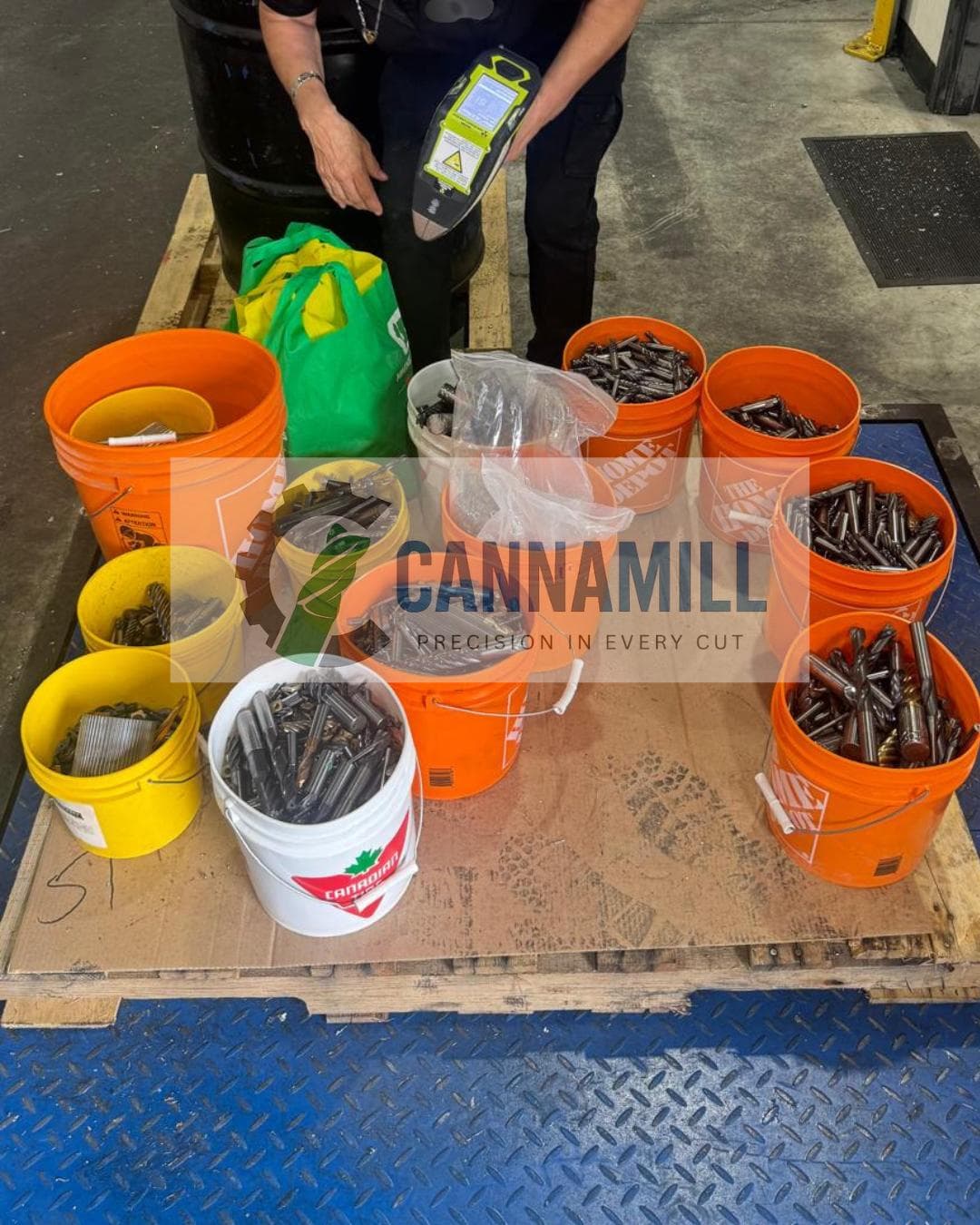
Using handheld X-ray fluorescence (XRF) analyzers, we verify the chemical composition, identifying the exact tungsten and cobalt ratios.
3. Zinc Processing & Crushing
For solid carbide scrap, the zinc process is often used. Molten zinc is reacted with the cobalt binder, causing the scrap tool to swell and disintegrate, separating the binder from the tungsten.
4. Chemical Extraction
For mixed, contaminated, or sludge scrap, chemical digestion is employed to dissolve individual metals, refining them back into high-purity chemical compounds.
5. Powder Metallurgy
The recovered tungsten and cobalt are milled and processed back into premium powders, ready to be sintered into brand-new industrial cutting tools.
Sorting and Purity Verification
The efficiency of the recycling process depends heavily on initial sorting. Steel attachments (shims, holders, shanks) and HSS tools introduce contaminants like iron, chrome, and vanadium, which are difficult to remove during physical refinement. For this reason, manual sorting and handheld XRF (X-ray fluorescence) spectrographic checks are performed at our vehicle during collection.
Environmental Benefits at a Glance
By recycling your shop's tooling rather than disposing of it, you contribute to:
- Energy Savings: Processing scrap uses 75% less electricity than refining raw ore.
- Emission Reduction: Substantial cuts in carbon dioxide emissions across the manufacturing lifecycle.
- Resource Conservation: Mitigates the open-pit mining load for tungsten and cobalt.
💡 Did you know?
- •Tungsten has the highest tensile strength of any metal at temperatures above 1,650°C.
- •Recycling 1 kilogram of tungsten carbide scrap prevents 4 kilograms of carbon dioxide from entering the atmosphere.
- •Sintered carbide tools can be recycled multiple times without any degradation in their mechanical properties.
- •The chemical digestion method allows for near-100% recovery of both tungsten and cobalt.
Recycling Science FAQ
What is the Zinc Process in carbide recycling?
The zinc process is a physical-chemical recycling method used for clean, sorted cemented carbide. The scrap carbide is placed in a vacuum furnace with metallic zinc and heated to about 900°C. The molten zinc diffuses into the cobalt binder matrix, forming a zinc-cobalt alloy. This alloy expands, breaking the structural bond between the tungsten carbide particles. The zinc is then distilled off, leaving behind a highly brittle sponge of tungsten carbide and cobalt, which can be easily crushed and milled back into high-grade powders without chemical changes.
What are the carbon footprint savings of recycling vs. mining?
Recycling tungsten carbide reduces carbon dioxide emissions by roughly 40% to 60% compared to mining raw ores (like wolframite) and refining them. Furthermore, recycling avoids the massive water consumption, open-pit land destruction, and chemical runoff hazards associated with primary tungsten mining.
Which industries are the largest consumers of recycled carbide?
CNC tool manufacturers (creating end mills, inserts, and drill bits) and mining equipment fabricators are the primary consumers. Recycled tungsten carbide powders meet the exact same chemical and structural specifications as virgin materials, allowing tool makers to maintain premium performance while lowering manufacturing costs.